Case Studies
Real-world examples of how we help organisations transform their digital infrastructure, operating models, and commercial outcomes.

1. AI Native Operating Models
Problem: A European operator had invested in data and automation but lacked a coherent operating model and architecture to translate these capabilities into operational impact. Prepicen defined a target operating model and supporting architecture, embedding AI-driven decision support into key workflows across network and service operations. The focus was on improving decision velocity, reducing manual intervention, and aligning teams around measurable outcomes. We embedded automated decision support and lightweight AI agents into key workflows.
Outcome: The new operating model led to materially faster incident resolution, a reduction in operational workload, and a sustained improvement in cost efficiency. It also created a more scalable foundation for further automation and performance management.

2. Private 5G & Industrial Connectivity
Problem: An infrastructure provider had demonstrated private connectivity in a pilot environment but lacked a scalable commercial proposition. Prepicen developed a structured industrial connectivity offer, integrating reliable connectivity with edge-based processing and operational systems. The proposition was aligned to specific industry use cases such as asset tracking, predictive maintenance, and automation.
Outcome: The approach enabled early commercial traction across multiple sites, improved operational efficiency for end clients, and established a repeatable model for scaling industrial connectivity solutions.

3. Techno-Economic Strategy
Problem: An investor was assessing opportunities across fibre and edge infrastructure but lacked clarity on long-term returns and risk exposure. Prepicen built a detailed techno-economic model covering cost structures, demand scenarios, and potential synergies, providing a robust foundation for investment prioritisation and selected M&A decisions.
Outcome: The analysis provided a clear basis for investment decisions, identified areas of potential overinvestment, and supported more disciplined capital allocation. It also improved confidence in expected returns and downside protection.

4. Digital Infrastructure Strategy
Problem: A large organisation faced rising infrastructure costs and increasing complexity across multiple environments, alongside growing regulatory requirements. Prepicen defined a coherent infrastructure strategy, establishing principles for workload placement based on cost, latency, resilience, and control. This included rationalising existing environments and identifying opportunities to optimise performance for latency-sensitive applications.
Outcome: The strategy reduced unnecessary cost, improved service performance, and ensured alignment with regulatory requirements, while providing a clear roadmap for future infrastructure evolution.

5. Platform & API Monetisation
Problem: A service provider had developed platform capabilities but struggled to generate meaningful revenue. Prepicen defined a monetisation strategy focused on high-value use cases, structured product offerings, and scalable partner engagement. This included pricing models, onboarding processes, and governance frameworks.
Outcome: The approach enabled the organisation to convert capabilities into revenue-generating products, increase partner activity, and establish a stronger commercial position within its ecosystem.

6. Ecosystem & Partnership Design
Problem: An organisation needed to deliver integrated solutions but lacked a structured partner strategy. Prepicen designed a targeted ecosystem, identifying key partners and defining collaboration models across technology, delivery, and commercial domains.
Outcome: The resulting ecosystem improved access to capabilities, accelerated solution development, and strengthened the organisation’s ability to win and deliver complex, multi-partner engagements.
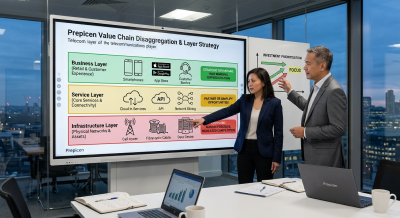
7. Value Chain Strategy
Problem: A telecommunications player faced margin pressure and increasing competition from new entrants across the value chain. Prepicen developed a structured view of value creation across infrastructure, service, and business layers, identifying where the organisation held advantage and where it was exposed.
Outcome: This enabled clearer strategic choices on where to invest, partner, or simplify, resulting in improved focus, stronger positioning, and more sustainable value creation.
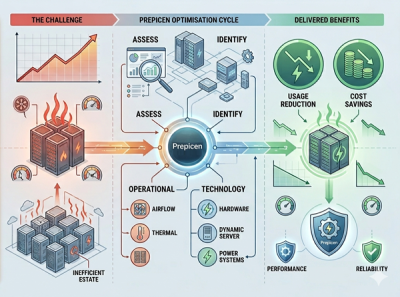
8. Energy & Cost Optimisation
Problem: A digital infrastructure operator experienced rising energy costs, impacting overall performance. Prepicen assessed energy consumption across the infrastructure estate and identified targeted optimisation opportunities, including operational improvements and technology adjustments.
Outcome: The programme delivered meaningful reductions in energy usage and operating cost, while maintaining performance and reliability, and established a more structured approach to managing energy as a core operational factor.